
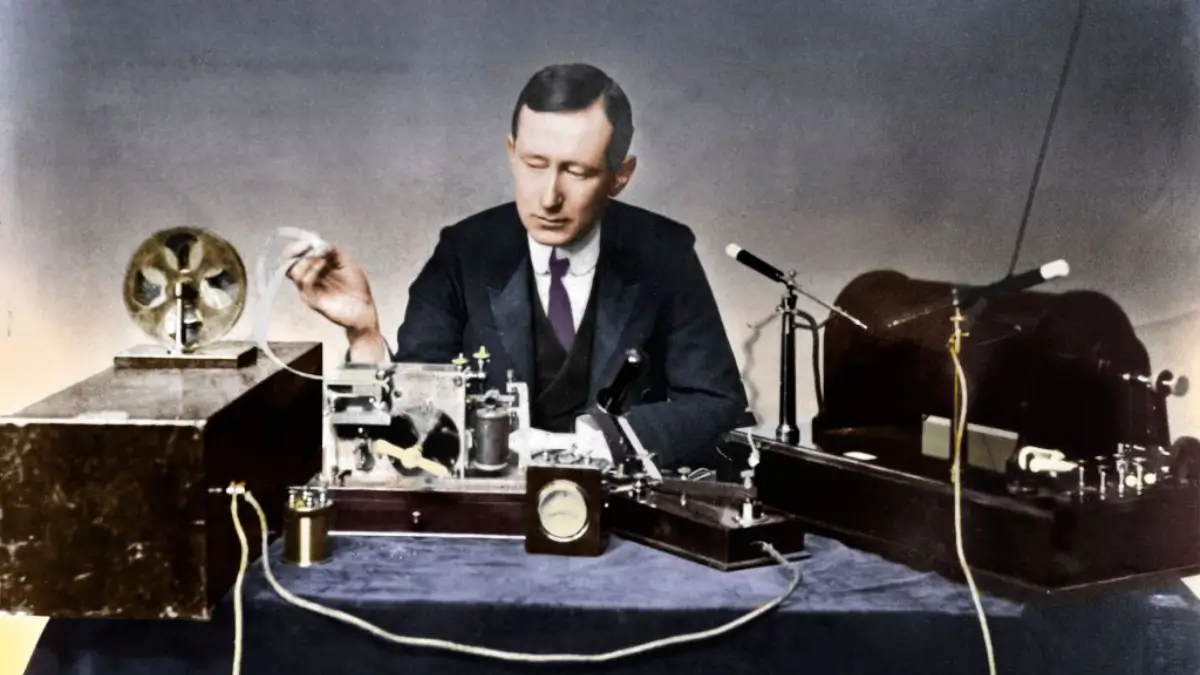
Radio is one of the most important inventions in the history of communication. It allows people to send messages without using wires, making long-distance communication much easier. But when we ask, “Who invented the radio?”, the answer is not as simple as one name. Many scientists worked on this idea, but one person is most widely recognized.
Who is the Inventor of Radio?
Guglielmo Marconi is called the “Father of Radio.” He was an Italian inventor who made the first practical system for sending messages through the air without wires.
In 1895, Marconi successfully sent wireless signals over a distance. By 1869, he received a patent for his invention. Later, in 1901, he achieved something amazing – he sent a wireless signal across the Atlantic Ocean. This proved that radio communication could work over very long distances.
Because of his work, Marconi shared the 1909 Nobel Prize in Physics with Ferdinand Braun.
Other Important Scientists Behind Radio
Even though Marconi is the most famous name, many other scientists helped make radio possible.
Nikola Tesla
Tesla worked on wireless technology before Marconi. He created important ideas and held early patents related to radio. In fact, in 1943, the U.S. Supreme Court recognized Tesla’s earlier work.
Jagadish Chandra Bose
Bose made important discoveries about radio waves, especially in the field of microwaves. His research helped scientists understand how wireless signals behave.
Heinrich Hertz
Hertz proved that electromagnetic waves exist. Without his discovery, radio would not have been possible.
Reginald Fessenden
Fessenden made the first radio broadcast of human voice in 1906, which was a big step forward from just sending signals.
Early Development Before Radio
Before radio became a reality, there were other inventions that helped in its development.
In 1880, Alexander Graham Bell created the photophone, which could send sound using light. Although it was not radio, it showed that wireless communication was possible.
Why Marconi Gets the Credit?
Many people contributed to the invention of radio, but Marconi is given the main credit because he turned scientific ideas into a working system. He made radio useful for real-life communication, especially for ships and long-distance messaging.
His work laid the foundation for modern technologies like television, mobile phones, and wireless internet.